


Blog
Gum Disease: Signs, Stages and Treatment (Dublin Dentist Guide)

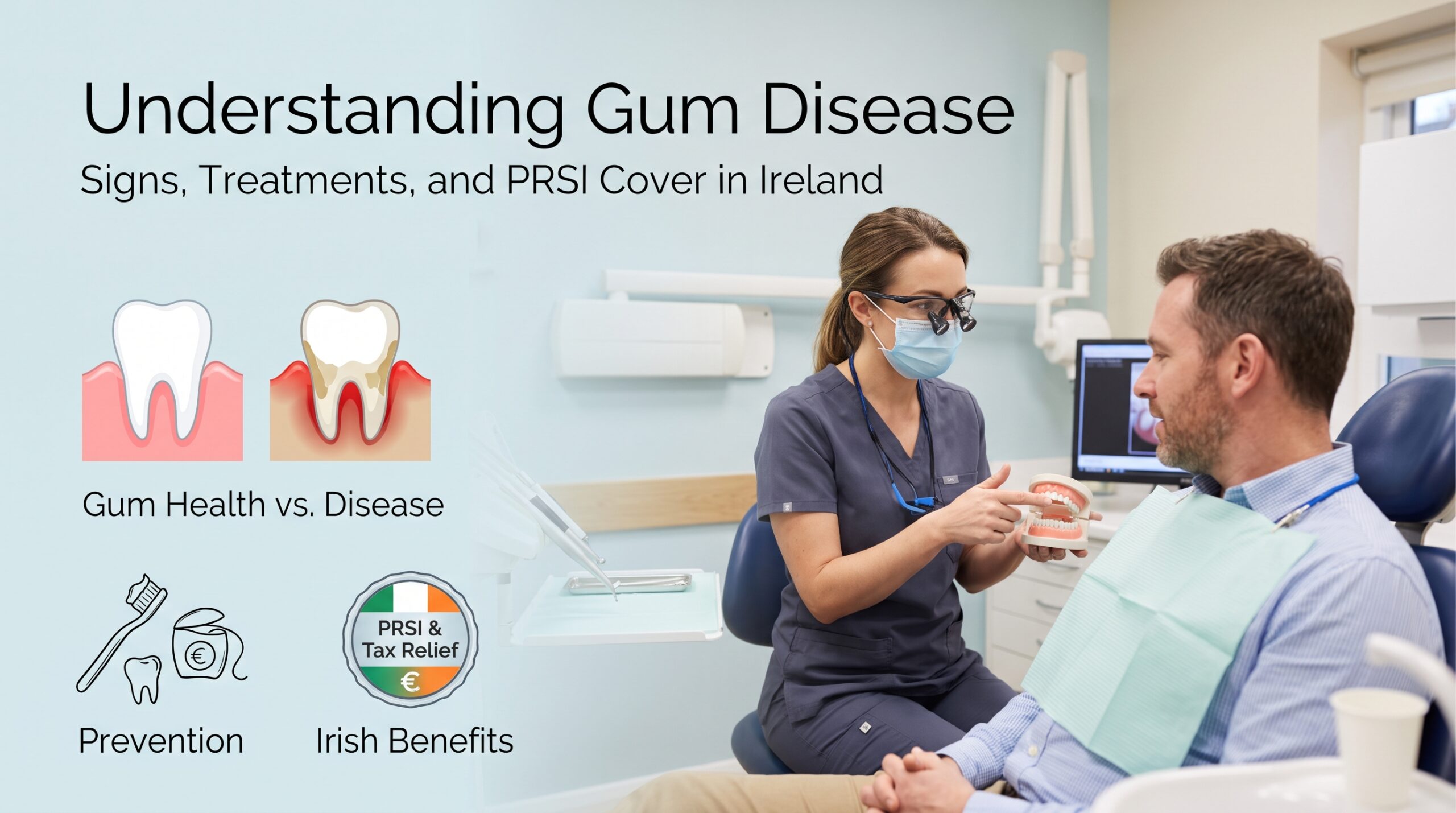
If your gums bleed when you brush, it’s tempting to brush more gently or skip that area. Healthy gums shouldn’t bleed, though, and bleeding is often the first sign of gum disease.
Gum disease is very common. The HSE says lots of adults in Ireland have some degree of it, and most people get it at least once. It isn’t always painful, so many people don’t know they have it until a check-up.
This guide covers the signs, the two main stages, how gum disease is treated, and what PRSI and tax relief cover in Ireland.
Gum disease at a glance
- Red, swollen gums that bleed when you brush are the early signs. This stage is called gingivitis.
- Gingivitis usually settles with better daily cleaning and a professional clean.
- Left untreated, it can become periodontitis, which damages the bone holding your teeth in place and can lead to tooth loss.
- Bone lost to periodontitis doesn’t usually grow back, but treatment can stop the disease getting worse.
- With enough PRSI contributions, you get a free dental exam each year and a contribution towards a scale and polish or gum treatment.
- Gum treatment such as root planing qualifies for Med 2 tax relief. A routine clean does not.
What is gum disease?
Gum disease is inflammation and infection of the gums and the tissues that support your teeth. It’s caused by plaque, a sticky film of bacteria that builds up on your teeth every day.
If plaque isn’t removed by brushing and cleaning between your teeth, it irritates the gums. Over time it hardens into tartar (also called calculus). You can’t brush tartar off. Only a dentist or hygienist can remove it.
Gum disease has two main stages:
- Gingivitis is the early stage. The gums are inflamed, but the bone that holds your teeth hasn’t been damaged.
- Periodontitis (also called periodontal disease) is the advanced stage. The infection spreads below the gum line to the ligament and jawbone that hold your teeth in place. Small gaps, called pockets, open up between the gum and the tooth.
Signs of gum disease
Healthy gums are pink and firm, hold your teeth securely and don’t bleed when you brush or floss. Gum disease often causes no pain, which is why it’s easy to miss.
Early signs (gingivitis)
- Gums that bleed when you brush or floss
- Red, puffy or swollen gums
- Gums that feel tender or sore
Signs of advanced gum disease (periodontitis)
- Bad breath (halitosis) that doesn’t go away
- An unpleasant taste in your mouth
- Gums pulling back from the teeth (receding gums), which can leave teeth looking longer or feeling sensitive. Our guide to dealing with tooth sensitivity explains why.
- Loose teeth that make eating difficult
- Gum abscesses: painful collections of pus under the gum or around a tooth
When to get seen quickly
Rarely, a severe form called necrotising periodontal disease (NPD) comes on suddenly. Contact a dentist promptly if you have painful, bleeding gums with ulcers, a metallic taste, a high temperature, or difficulty swallowing or talking. We offer emergency appointments in Dundrum.
Gingivitis vs periodontitis: what’s the difference?
Gingivitis affects only the gums and can usually be reversed. Periodontitis reaches the bone, and while the damage is lasting, the disease can be controlled.
| Gingivitis | Periodontitis | |
| What’s affected | Gums only | Gums, the ligament around each tooth, and the jawbone |
| Typical signs | Red, swollen gums that bleed when you brush | Bad breath, receding gums, loose teeth, abscesses |
| Can it be reversed? | Usually, yes | Bone loss is lasting, but the disease can be kept stable |
| Usual treatment | Better home care and a scale and polish | Deep cleaning below the gum line, then regular maintenance; sometimes surgery |
What causes gum disease, and who is more at risk?
The main cause is plaque left on the teeth, usually because brushing or cleaning between the teeth is rushed or skipped. Some things make gum disease more likely, or harder to keep under control. The HSE lists:
- Smoking and vaping
- Diabetes
- Pregnancy, because of hormonal changes
- Getting older
- A weakened immune system, for example from HIV or chemotherapy
- Stress
- Poor nutrition
- Medicines that cause a dry mouth, such as some antidepressants and antihistamines
The HSE describes smoking as one of the biggest risk factors for gum disease. If any of these apply to you, tell your dentist, as you may need check-ups and cleans more often. Everyday habits matter too: see 7 habits that are jeopardising your dental health.
Is gum disease reversible?
Gingivitis is. Once plaque and tartar are removed, and you keep them off with good daily cleaning, inflamed gums usually settle. The HSE notes that gingivitis improves with better brushing.
Periodontitis is different. Bone lost around the teeth doesn’t usually grow back on its own. Treatment aims to stop the disease getting worse and keep your gums stable, which is why follow-up visits matter as much as the first clean.
If your gums still bleed after you’ve improved your brushing and started cleaning between your teeth, book a check-up rather than waiting.
How we check your gums
A gum check is part of every routine dental exam and only takes a few minutes.
- We look at the colour and shape of your gums, and check for bleeding, tartar and loose teeth.
- We gently measure the pocket around each tooth with a thin probe marked in millimetres. Healthy gums have shallow pockets. Deeper pockets suggest periodontitis.
- If we suspect bone loss, we may take X-rays to see the bone levels around your teeth.
- We explain what we’ve found and agree a plan with you, including when to come back.
Pocket depth also matters for PRSI. The Department of Social Protection’s dental fee rules class periodontal treatment as treatment for pockets deeper than 3.5mm, such as root planing. Milder gum problems come under a standard scale and polish.
How gum disease is treated
Treatment depends on how far the disease has gone. Most people need professional cleaning plus better cleaning at home.
1. Better cleaning at home
This is the most important part of any treatment, and the part only you can do. We’ll show you where plaque is being missed and how to clean between your teeth with floss or interdental brushes. Our guide on how to brush your teeth properly covers the technique step by step.
2. Scale and polish
A professional clean removes plaque and tartar and then polishes the teeth. For gingivitis, this plus good home care is usually enough. If there’s a lot of build-up, you may need more than one visit.
3. Deep cleaning (root planing)
For periodontitis, we clean below the gum line to remove bacteria and tartar from the root surfaces. This is also called debridement. We use local anaesthetic to numb the area, and deep cleaning is priced per arch (your upper or lower teeth). Afterwards, your gums may feel sore or tender for up to 48 hours.
If you feel nervous about treatment, tell us when you book. Our article on dental anxiety and how to overcome it has some practical tips.
4. Antiseptic mouthwash or antibiotics
Your dentist may suggest an antiseptic mouthwash such as chlorhexidine for a short time. It doesn’t remove plaque, so it’s an add-on to brushing, not a replacement. The HSE notes that chlorhexidine can stain teeth. Wait 30 minutes after brushing before using it, and don’t use it for more than 4 weeks. Antibiotics are sometimes used alongside deep cleaning or surgery, but only when your dentist advises it.
5. Referral for advanced cases
Severe periodontitis may need gum surgery to reach deep pockets, or removal of a tooth that can’t be saved. If that’s the case, we’ll explain your options and, where needed, refer you to a dentist with advanced training in gum treatment (often called a periodontist).
6. Ongoing maintenance
Once gum disease is under control, regular check-ups and cleans help keep it stable. If you’ve had gum disease before, you’ll usually need to come in more often than someone who hasn’t. Here’s why skipping dental cleanings costs you money in the long run.
Gum disease and your general health
Research has linked periodontitis with other health conditions, mainly diabetes and heart disease. A link doesn’t prove that one causes the other, and studies are ongoing. Even so, European gum and heart experts now advise dentists to tell patients about these links.
- Diabetes: People with diabetes are more likely to get gum disease. Moderate to severe periodontitis is also linked with a higher risk of diabetes developing or getting worse.
- Heart disease: Periodontitis is associated with a higher risk of a first heart attack or stroke, even after allowing for shared risks such as smoking.
- Pregnancy: Hormonal changes make the gums more prone to inflammation, so keep up your check-ups while pregnant.
If you have diabetes or a heart condition, let us know at your visit so we can plan your care around it.
Gum disease, missing teeth and dental implants
Untreated periodontitis can loosen teeth until they fall out or need to come out. If you’ve already lost a tooth, read why waiting could limit your treatment options.
Dental implants can replace teeth lost to gum disease, but your gums need to be healthy and stable first. Implants can develop a similar problem called peri-implantitis, where inflammation causes bone loss around the implant. The European Federation of Periodontology lists its main risk factors as a history of periodontitis, poor oral hygiene and missing regular follow-up care.
That’s why, before we plan a single tooth implant or full arch implants, we check your gums and treat any active disease. A 3D CBCT scan shows how much bone there is to work with. After treatment, regular check-ups and cleans help protect your implants.
If you wear dentures because of past gum problems, see our guide to replacing dentures with dental implants, or book a free implant consultation.
What does gum treatment cost, and what can you claim back?
In Ireland, PRSI and tax relief can both reduce the cost of gum care, but they cover different things.
PRSI dental benefit (Treatment Benefit)
If you have enough PRSI contributions, the Treatment Benefit scheme gives you, once each calendar year:
- a free dental exam, and
- a contribution towards either a scale and polish or periodontal (gum) treatment, but not both.
For a standard scale and polish, the most you can be charged on top is €15. There’s no such cap for periodontal treatment, so you pay the difference between the Department’s contribution and the fee. At Happy Dental, the PRSI exam and clean costs €15.
You can check your entitlement on MyWelfare.ie, or our reception team can check it for you with your PPS number. Read more about PRSI dental treatment at Happy Dental and how not to waste your PRSI exam and cleaning.
Med 2 tax relief
Revenue treats periodontal treatment for gum disease as non-routine dental care, so you can claim tax relief on it. Revenue’s list includes root planing (including curettage and debridement) and gum flaps. Routine care, including scaling and cleaning, does not qualify.
Relief is given at the standard rate of tax (20%), and you can claim for the previous four years. We complete a Med 2 form for qualifying treatment. PAYE workers then claim through Revenue’s my Account, and self-employed people claim on their Form 11. Keep the Med 2 in your records in case Revenue asks for it. Our page on dental tax relief explains the process.
Our prices
At the time of writing (November 2026), a scale and polish costs €60 and deep cleaning costs €120 per arch, including local anaesthetic. An adult consultation is €50. See our full price list for current fees.
How to prevent gum disease at home
Good daily cleaning and regular check-ups are the best protection against gum disease.
- Brush twice a day for 2 minutes, including last thing at night. Manual and electric toothbrushes both work well if you use them properly.
- Use a fluoride toothpaste, then spit it out rather than rinsing with water, so the fluoride stays on your teeth.
- Clean between your teeth every day with floss or interdental brushes. The HSE suggests doing this before you brush.
- Don’t smoke or vape. Stopping smoking can make a real difference to your gum health.
- Cut back on sugary snacks between meals. Frequent snacking feeds the bacteria in plaque. Read how snacking can mess with your oral health.
- Keep up your check-ups. The HSE advises seeing a dentist at least every 1 to 2 years, and more often if you’ve had gum disease or are at higher risk. We’ll tell you the right interval for you.
When to see a dentist about your gums
Book a check-up if your gums bleed when you brush, look red or swollen, or you’ve noticed bad breath, receding gums or a loose tooth. The earlier gum disease is found, the simpler it usually is to treat.
Happy Dental is in Dundrum, Dublin 14. Call us on 01 558 2015 or book an appointment online. If you qualify for PRSI dental benefit, ask about your annual exam and clean for €15. You can also meet our team before your visit.
Frequently asked questions
Is it normal for gums to bleed when you brush?
No. Healthy gums shouldn’t bleed when you brush or touch them. Bleeding is usually an early sign of gingivitis. Keep brushing thoroughly, clean between your teeth daily, and book a check-up if the bleeding doesn’t settle.
Can gingivitis go away on its own?
Not without changes. Gingivitis clears when the plaque causing it is removed and kept off. Tartar can’t be brushed away, so a professional clean is often needed alongside better brushing and cleaning between your teeth.
Does a deep clean hurt?
We use local anaesthetic to numb the area during treatment. Afterwards, your gums may feel sore or tender for up to 48 hours.
Does PRSI cover gum disease treatment?
Partly. The Treatment Benefit scheme gives a yearly contribution towards either a scale and polish or periodontal treatment. For a scale and polish, your top-up is capped at €15. For periodontal treatment, there’s no cap, so you pay the balance of the fee.
Can I claim tax relief on gum treatment?
Yes, for periodontal treatment such as root planing, which Revenue treats as non-routine. Relief is at 20% using a Med 2 form. A routine scale and polish doesn’t qualify.
Can I get dental implants if I’ve had gum disease?
Often, yes, once the gum disease has been treated and is stable. A history of periodontitis raises the risk of problems around implants, so good daily cleaning and regular check-ups are important afterwards.
How often should I have my teeth and gums checked?
The HSE advises a check-up at least every 1 to 2 years if your mouth is healthy. If you’ve had gum disease, or have a risk factor such as diabetes or smoking, you’ll usually need to come more often. Your dentist will advise you.
Sources
- HSE: Gum disease overview, symptoms, causes, treatment and complications
- Revenue: Dental expenses, Health expenses and How to claim health expenses
- Irish Statute Book: I. No. 23/2026, payments for dental Treatment Benefit
- European Federation of Periodontology: periodontitis and cardiovascular disease workshop and guideline on peri-implant diseases (Dental Tribune report)
- AAP and EFP consensus on periodontitis and diabetes: Dr Bicuspid summary
This article is general information and isn’t a substitute for a dental examination. Your dentist will advise on the right treatment for you.
